Lumiel
PROJECT TYPE
AI-powered emotional companion
CATEGORY
Mobile App
YEAR
2026
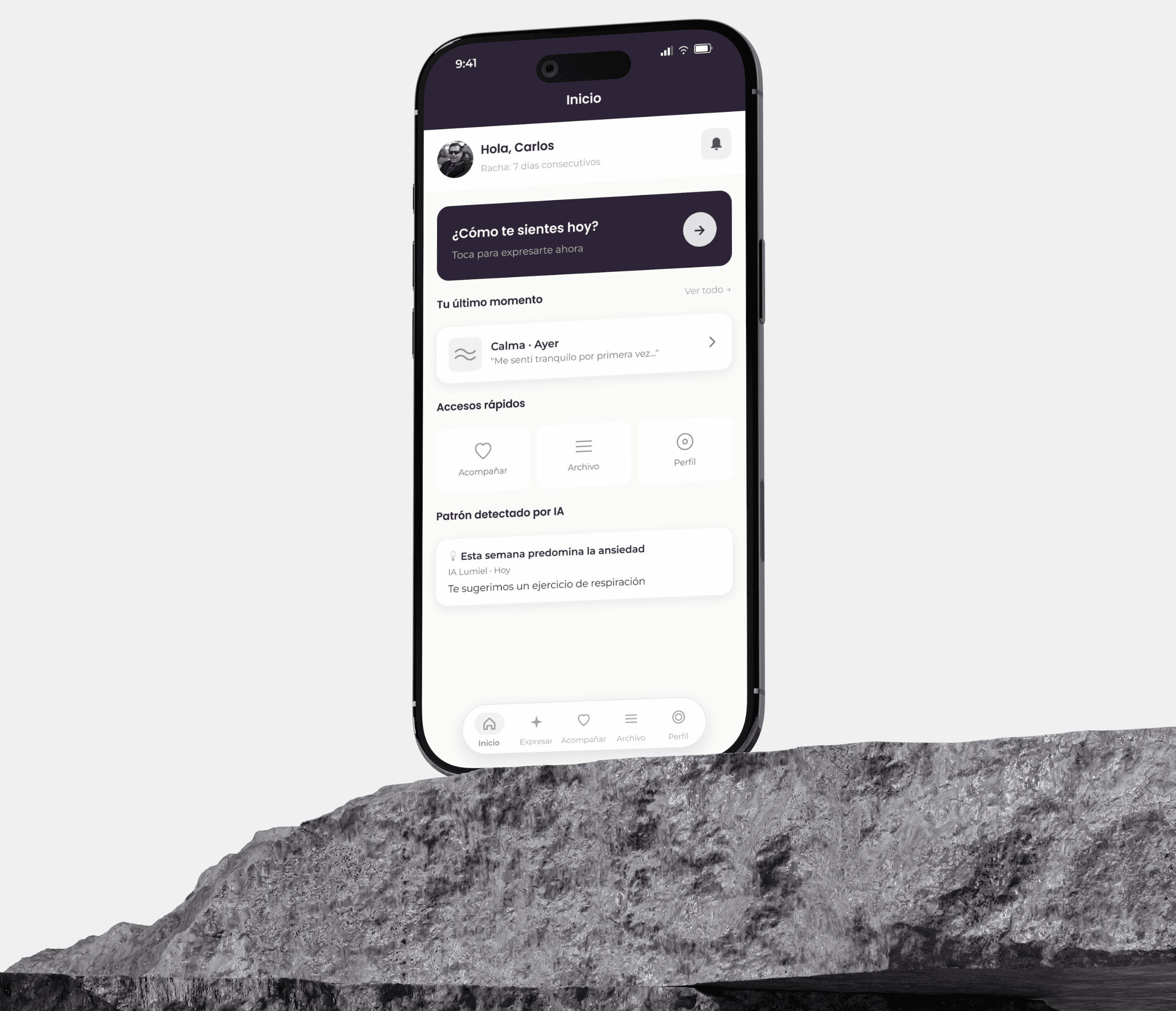
Lumiel is an AI-powered emotional companion designed for people who need support but aren't ready — or don't need — to take the step towards professional therapy. It lets users log emotions, detect behavioural patterns and receive empathetic, non-generic guidance. The core principle: accompany without replacing, support without judging.
THE CHALLENGE
Most people who struggle emotionally sit in a gap: they're sceptical of self-help apps, but they don't feel their situation justifies professional help either. Existing solutions make that gap worse — they either feel too clinical, too generic, or they quietly punish users for inconsistency through streaks, guilt mechanics and passive-aggressive notifications.
The challenge was designing an experience that felt genuinely warm and human from the very first interaction, that adapted to each person's actual needs and that never made anyone feel like they were failing at their own mental health.
The project started with a clear hypothesis: the problem isn't awareness of mental health tools, it's trust and perceived relevance. To validate this, I built a full research foundation — problem statement, research questions, competitive benchmarking, SWOT analysis and competitive differentiation — before talking to any users.
Benchmarking revealed a consistent pattern across existing apps: heavy gamification, generic content and a clinical tone that created distance instead of connection. None of them felt like something you'd open on a bad day.
Surveys and interviews confirmed the hypothesis. Users didn't distrust the concept of emotional support — they distrusted the execution. The language felt automated. The experience felt transactional. Nobody wanted another app that tracked their mood like a fitness metric.
Define & Synthesise
Research findings were organised into profiles, an affinity map and a full research summary. From there I built the core UX artefacts: user personas, journey maps, Jobs To Be Done, empathy maps and a structured set of insights.
The key insight that shaped every subsequent decision: users needed to feel accompanied, not monitored. That single distinction drove the information architecture, the conversational tone of the AI, the absence of punitive mechanics and the decision to make every feature optional and pressure-free.
HMW questions were defined from the insights before any design work began.
Design & Iteration
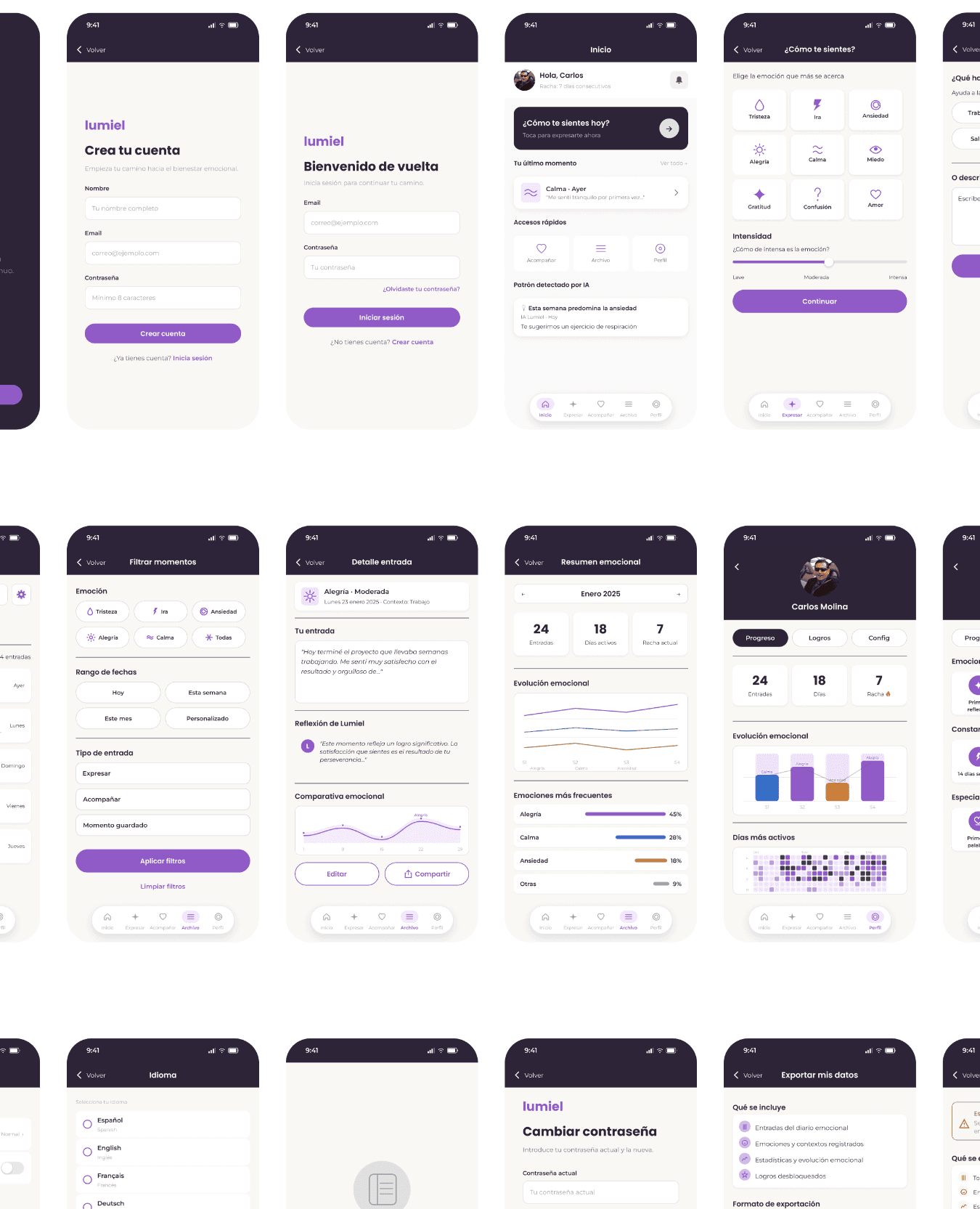
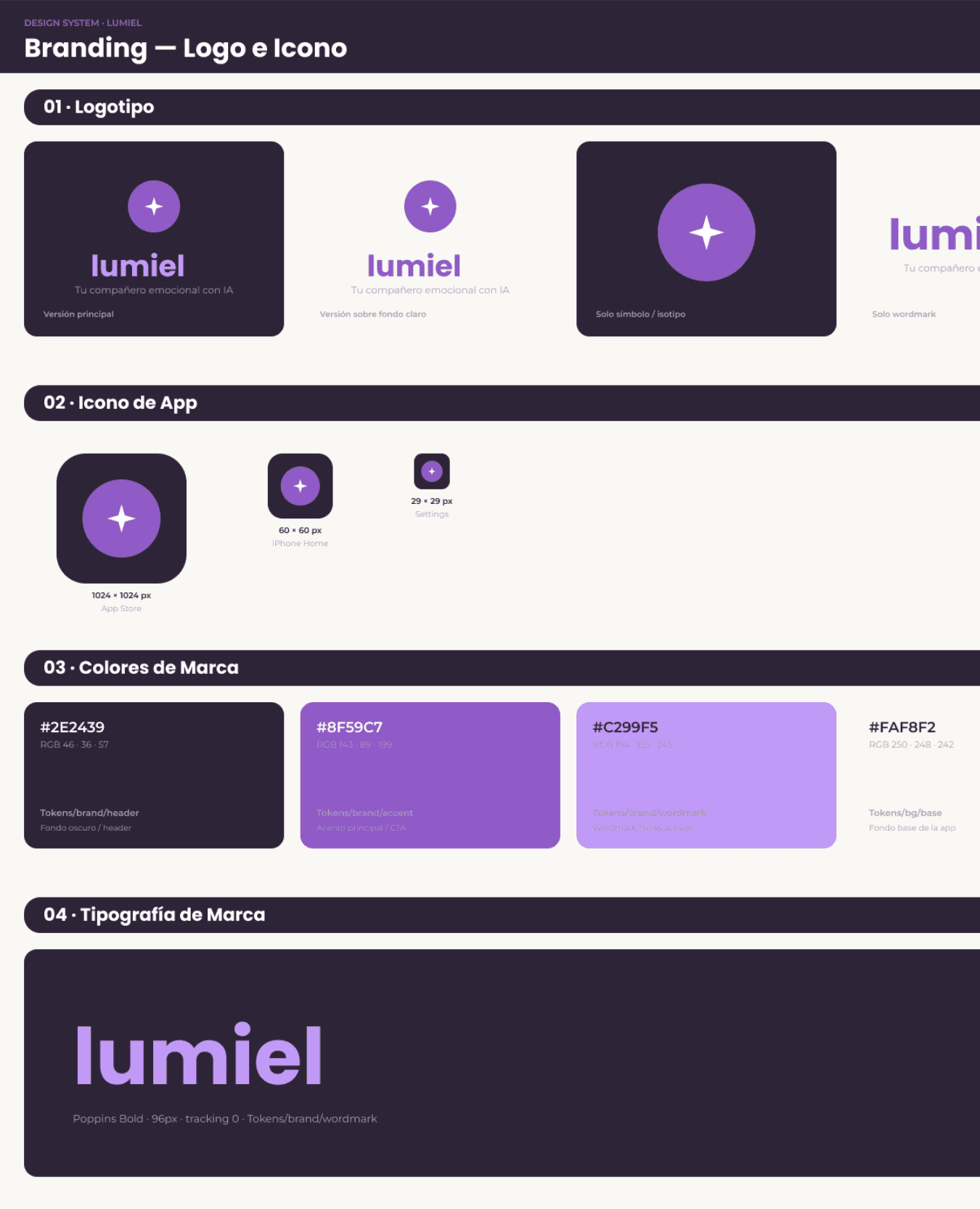
I started by designing one key screen at high fidelity — the home dashboard. That screen established the entire visual language of the project: the purple palette, the typographic hierarchy, the spatial rhythm. From it I built the full design system before working through low and mid fidelity screens systematically.
The colour choice was deliberate. Purple sits outside the blue of clinical health and the green of generic wellness. It carries associations of introspection and calm presence without feeling cold or institutional. Combined with high contrast and generous whitespace, the result is an interface that feels grounded and warm rather than sterile.
Every screen was fully resolved before prototyping began. The prototype was built to test, not to explore.
Validation
Usability testing was conducted with 5 real participants using five defined tasks:
Onboarding and initial setup — completing registration, selecting frequent emotions and configuring a first reminder.
Logging an emotional entry — creating a new entry, selecting an emotion and saving it.
Exploring history and active streak — finding last week's entries and checking streak status.
Starting an AI accompaniment session — opening Lumiel and exchanging at least two messages with the assistant.
Accessing profile and monthly statistics — navigating to profile, reviewing the emotional summary and editing personal data.
Overall task success rate: 84%. Users completed the core flows without friction and responded positively to the empathetic tone of the AI interactions.
Two friction points were identified: one visual element that users expected to find in a different location, and the history navigation, which wasn't immediately intuitive. Both were iterated on after testing. Neither required structural changes — they were positioning and labelling decisions that the test made visible.
Conclusion
Lumiel demonstrates that the difference between an app people abandon and one that genuinely accompanies them isn't feature depth — it's the quality of every micro-decision. Tone, hierarchy, the absence of pressure, the warmth of the first screen. Every one of those decisions has a research finding behind it.
User-centred design isn't a methodology. It's the reason the product works.